Materials able to sense, move, communicate, and learn are the holy grail of materials science as they will bring disruptive advances in the megatrends of energy, information, and health. Although great progress has been made in the development of stimuli-responsive polymers, the fundamental knowledge on how to embody self-regulation and autonomous function in soft matter is unknown. To overcome this challenge, we employ a supramolecular approach where dynamic non-covalent interactions provide the action.
This challenge brings us to explore two major directions:
Fundamentals of complex (supra)molecular systems
How does matter become complex?
Interactive supramolecular materials
How to bring materials to life?
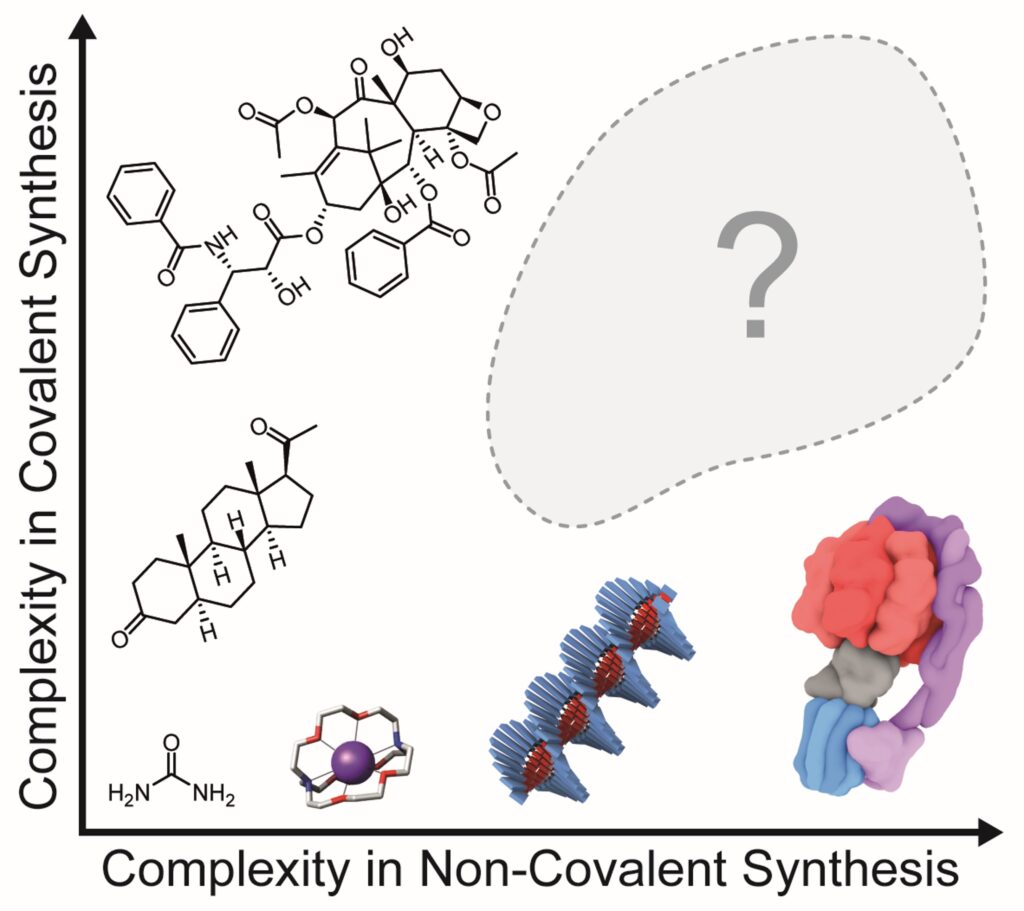
We try to answer this question by synthesizing complex molecular systems, exploring how to control the structure, dynamics, and function of supramolecular polymers. We develop synthetic tools to transform molecular self-assembly into multistep synthesis involving covalent and noncovalent reactions. Seeking for methods to rationalize the design of supramolecular systems and to expand the chemical space available, we recently use high-throughput screening coupled with computational tools.
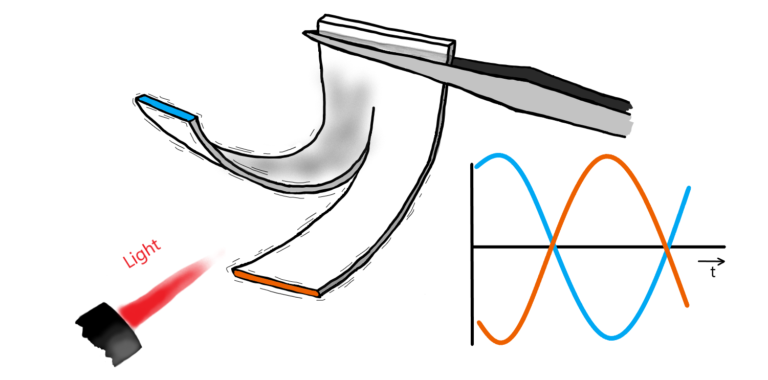
We amplify molecular events into macroscopic function by the control of cooperative effects in highly ordered one- or two-dimensional nanostructures. Following a macro-organic chemistry approach, we synthesize materials at the boundaries between liquid crystal and block copolymer chemistry and merge the best of both worlds: molecular precision with polymer functionality. Plastics with unprecedented properties such as oscillation and synchronized motion have recently been made.